
Incoterms Rules
What are Incoterms?
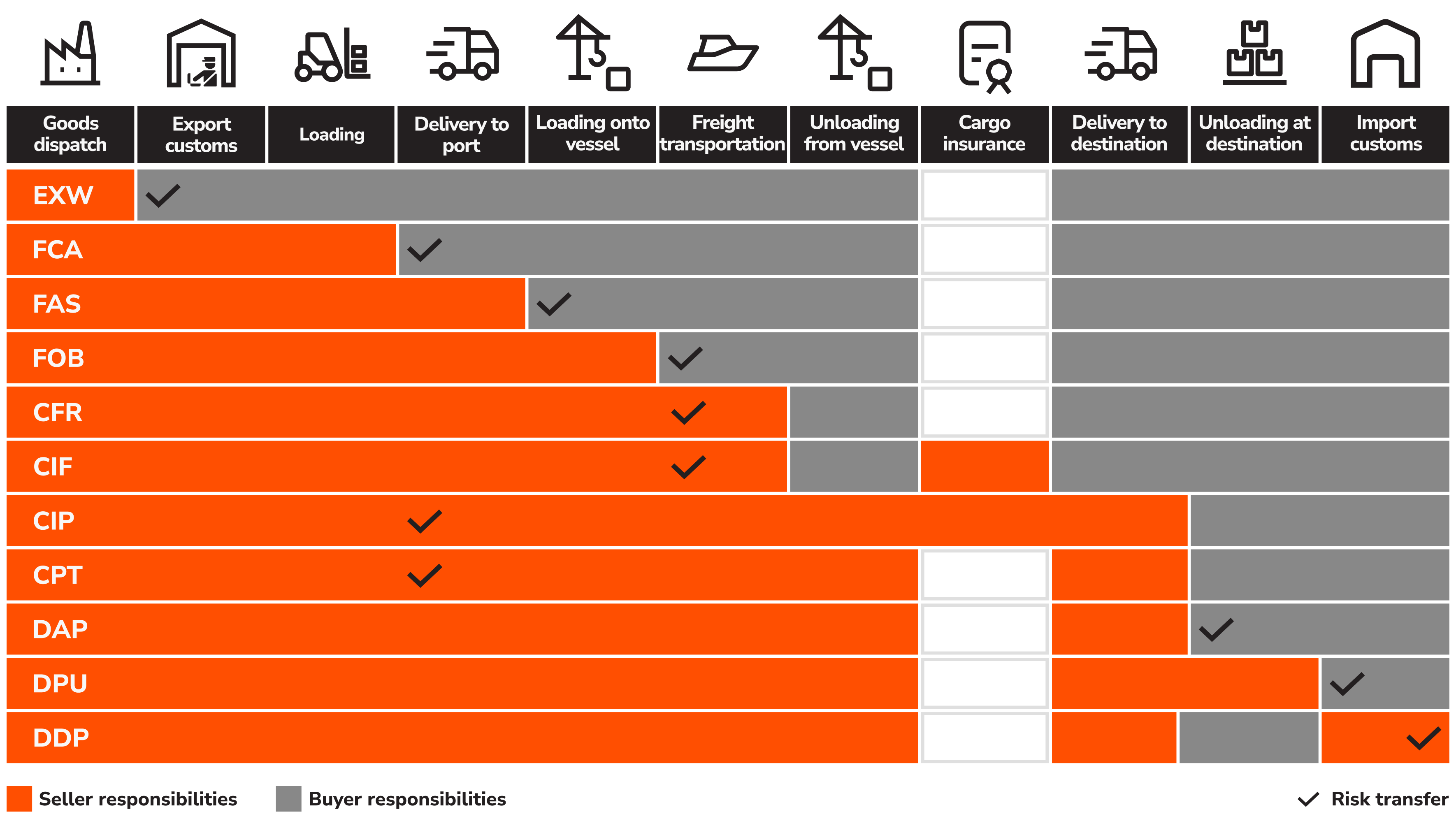
Incoterms (International Commercial Terms) are international rules that define the terms of delivery for goods in international trade. They specify who is responsible for transportation, insurance, and customs clearance, as well as the point at which risks transfer from the seller to the buyer. The Incoterms rules were developed by the International Chamber of Commerce and are used worldwide to standardize contracts and reduce the risk of misunderstandings between parties.
The latest edition is Incoterms 2020, which includes 11 rules categorized by mode of transport.
EXW
EXW (Ex Works) is the simplest term, under which the seller has minimal obligations. The seller merely makes the goods available at their premises or warehouse, with no obligation to load the goods or handle export formalities. All costs and risks, including transportation, customs clearance, and delivery, are borne by the buyer. This approach is advantageous for the seller but places a significant burden on the buyer, especially in international trade.
FCA
Under FCA (Free Carrier), the seller assumes greater responsibility. The seller delivers the goods to the carrier selected by the buyer at an agreed location—which may be the seller’s warehouse or another location. The seller is also responsible for export clearance. Risks transfer at the moment the goods are handed over to the carrier. This term is considered one of the most versatile and is frequently used for various modes of transport.
FAS
FAS (Free Alongside Ship) is used exclusively in maritime transport. The seller delivers the goods to the port of shipment and places them alongside the vessel. At this point, the risks transfer to the buyer, who then organizes loading, transportation, and further stages. This term is mainly used for bulk or oversized cargo.
FOB
Under FOB (Free On Board) terms, the seller is responsible for delivering the goods to the port and loading them onto the vessel. The risks transfer to the buyer once the goods pass the ship’s rail. This is one of the most commonly used terms in maritime trade, especially for commodities such as grain or metals.
CFR
In the case of CFR (Cost and Freight), the seller pays for transportation to the destination port, but the risks transfer to the buyer at the moment of shipment — after the goods are loaded onto the vessel. This means that although the seller covers transport costs, the buyer bears responsibility for the goods during transit.
CIF
CIF (Cost, Insurance and Freight) extends CFR terms by including mandatory cargo insurance provided by the seller. However, the insurance usually offers minimal coverage. As with CFR, the risks transfer after loading onto the vessel, but the buyer receives basic protection against potential losses during transportation.
CPT
Under CPT (Carriage Paid To), the seller pays for transportation to the agreed destination, but the risks transfer to the buyer as soon as the goods are handed over to the first carrier. This creates a key distinction between costs and risks: the seller pays for delivery but is not responsible for the goods in transit.
CIP
Similar to CPT, CIP (Carriage and Insurance Paid To) also includes insurance coverage provided by the seller. Unlike CIF, it requires a higher level of insurance coverage. This makes CIP safer for the buyer, especially in multimodal transportation.
DAP
Under DAP (Delivered at Place), the seller is responsible for organizing and covering the costs of delivering the goods to the specified destination. Risks transfer when the goods arrive and are ready for unloading. The buyer is responsible for import clearance and unloading.
DPU
DPU (Delivered at Place Unloaded) is the only term where the seller is responsible not only for delivery but also for unloading the goods at the destination. This means a higher level of responsibility for the seller and greater convenience for the buyer, who receives the goods already unloaded.
DDP
DDP (Delivered Duty Paid) represents the maximum obligation for the seller. In this case, the seller assumes all costs and risks, including transportation, insurance, customs clearance, and payment of duties and taxes. The buyer receives the goods ready for use without being involved in logistics processes.